
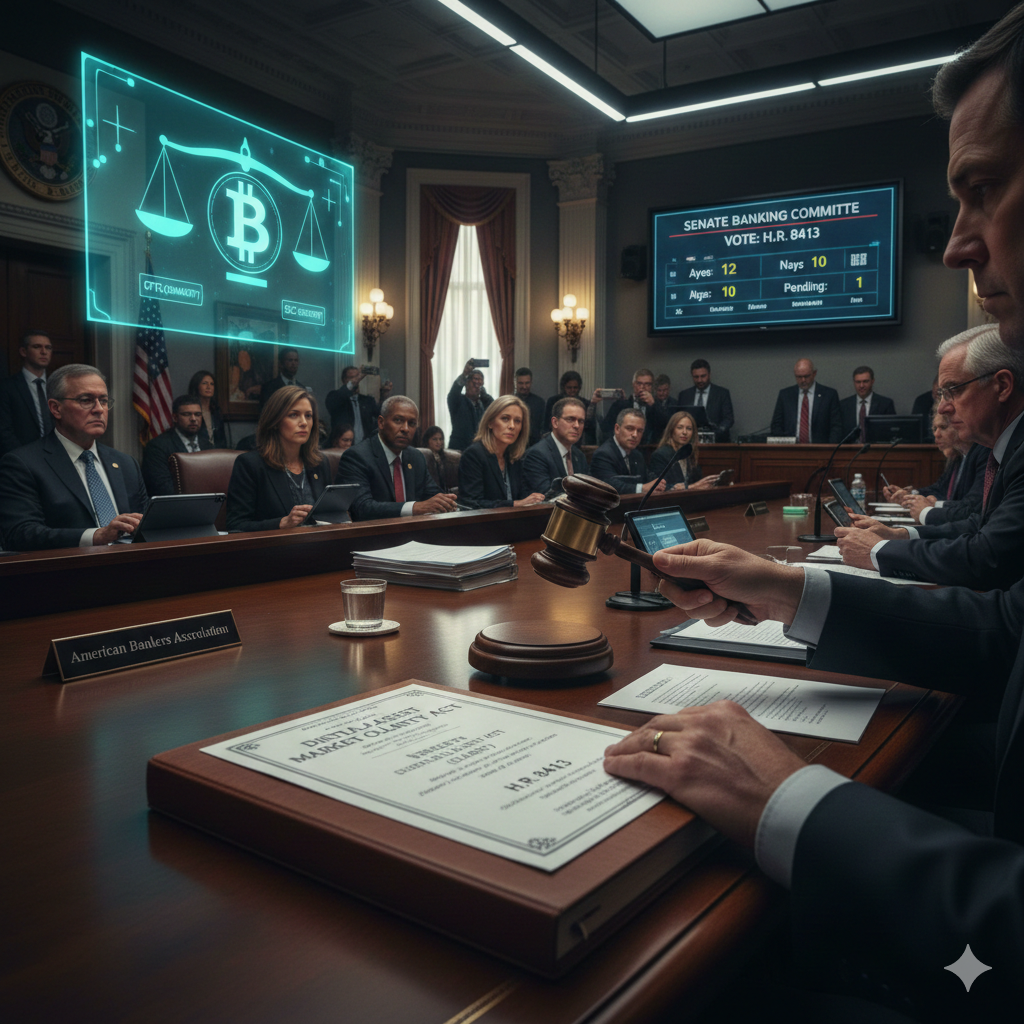
The first major political showdown of 2026 is officially on the calendar. On January 15, the U.S. Senate Banking Committee is scheduled to vote on a piece of legislation that could end years of jurisdictional infighting and provide the digital asset industry with something it has lacked since its inception: Certainty.
Known as the Digital Asset Market Clarity Act (CLARITY), this bill represents the most significant attempt to date to modernize the American financial system for the blockchain era.
Ending the “Regulation by Enforcement” Era
For the past several years, the U.S. crypto industry has been caught in a tug-of-war between two powerful regulators: the Securities and Exchange Commission (SEC) and the Commodity Futures Trading Commission (CFTC).
The CLARITY Act aims to draw a “line in the sand.” Under the proposed 2026 framework:
- Bitcoin as a Commodity: The bill officially classifies Bitcoin as a digital commodity, placing it under the oversight of the CFTC.
- The SEC’s Role: The SEC would maintain authority over centralized tokens that function like securities, ensuring consumer protections and disclosure requirements remain intact.
By defining these boundaries, the bill seeks to move the U.S. away from “regulation by enforcement”—where rules are often decided in courtrooms—and toward a clear, legislative “rule of law.”
The “Sovereign Reserve” Momentum
The January 15 vote doesn’t exist in a vacuum. It follows a wave of momentum regarding the U.S. Strategic Bitcoin Reserve. As the administration explores the potential of holding Bitcoin as a national treasury asset, the need for a legal framework like the CLARITY Act becomes urgent.
Political analysts suggest that the government cannot effectively manage a strategic reserve if the legal status of the asset itself remains in a “gray area.” Passing this act would provide the structural foundation needed for the U.S. Treasury to treat Bitcoin as a legitimate component of the national balance sheet.
The Economic Debate: Banking vs. Innovation
Despite the optimism in the tech sector, the bill faces stiff opposition from traditional finance. On January 6, 2026, the American Bankers Association (ABA) expressed concerns that the new rules might allow digital asset firms to compete with traditional banks without the same “know-your-customer” (KYC) and capital reserve burdens.
This tension between “Legacy Finance” and “Digital Innovation” will be the primary theme of the Senate hearings. Lawmakers are tasked with a difficult balancing act: fostering American innovation while ensuring the stability of the traditional banking system.
What This Means for the 2026 Market
While the market has remained relatively stable in early January—trading in a tight range between $90,000 and $93,000—investors are clearly waiting for a signal from Washington. A “Yes” vote on January 15 would likely signal to institutional investors that the “regulatory risk” of entering the U.S. market has been significantly lowered.
Conclusion
The January 15 vote is more than just a bureaucratic hurdle; it is a test of America’s willingness to lead the global digital economy. As we move closer to the mid-2026 economic cycle, all eyes remain on the Senate Banking Committee.